8 min read
The hidden cost of custom software development services for manufacturing industry
8 min read
The hidden cost of custom software development services for manufacturing industry

When a manufacturer commissions software to track production or integrate an ERP system, they often get a standard enterprise architecture. Most of these struggle the moment they meet the physical constraints of a live shop floor.
Template software is built for average operations. A plant is not average. Every line has its own micro processes, its own tolerances, and its own order of steps that has to run exactly right.
That calls for custom software development that fits right with your processes. The best software development teams for a manufacturing project are the ones who already know the industry in and out.
Table of contents
The translation cost problem
Pavesoft's zero ramp up process
Comparing with the alternatives
Our traceability software for a tier-1 automotive company
What we build at Pavesoft
50+ enterprise projects
What is the “translation-cost” problem?
The biggest cost in such an engagement is not the hourly rate. It is the ongoing translation cost; the time your plant experts spend teaching developers about general industrial processes.
The 2026 ICIS research on outsourced software projects confirms that this kind of domain-specific knowledge creates measurable coordination problems.

Manufacturing runs on knowledge that lives in people’s heads. Operators know which fault codes matter and which ones they ignore.
Shift supervisors know why a batch gets held. None of it sits in a requirements document, so someone has to pull it out. Every hour that takes is an hour you pay for.
This is an industry-wide gap, not a failure of any one team. Most software teams have never worked on a plant floor, so they start from zero.
The cost shows up in three places:
Discovery runs for months while developers learn your vocabulary.
The build solves the wrong problem because a requirement got lost in translation.
The floor team rejects the first release, and the rework starts.
To close this exact gap, you need a team that does not require a domain ramp-up. A team that has built 50+ enterprise-grade software in complex and regulated environments like yours.
What zero ramp-up and no rework looks like
On a typical project, the first 3-4 weeks are for the domain ramp-up where the team is made familiar with the processes and terminology. The technical requirements gathering comes after.
At Pavesoft, we have teams that specialize in building software for heavy industrial operations. Our engineers already know operators, fault codes, shift handoffs, and line-stops.
In addition to that, Paveway Automation, our integration partner for the physical layer, already knows the PLCs, sensors, and line controls.
Requirements move to phase one, and your floor team sees working software every week.

Comparing with the alternatives
The table below shows where each route lands.
In-house team | Large consultancy | Staff augmentation | Pavesoft Technologies | |
|---|---|---|---|---|
Where translation cost lands | In the months spent hiring and teaching new developers | In fees, while the team learns your operation | In rework after the build misses your process | Nowhere. The domain knowledge arrives with the team |
Domain knowledge on day one | Built over time | Broad, not specific to your floor | Rarely | Manufacturing-specific from week one |
Floor and software coordination | Your team manages it | Split across vendors | Your team manages it | One partnership with Paveway Automation |
Who owns the outcome | You do, long after the project ends | The contract scope | You do | We do. We stay until results show on the floor |
How Pavesoft built a traceability software for a tier 1 automotive supplier
A Tier-1 automotive supplier needed to expand an assembly line with precise per-part traceability software.
While Paveway Automation handled the floor, Pavesoft built the software and data layer. Our engineers started with the supplier’s real process, so nobody spent weeks teaching developers how the line runs.
The line moved from batch-level to unit-level traceability with two major outcomes:
Units condemned per defect event: from 1,000 to 10,000 down to 1.
Assembly cycle time per unit: from about 14 minutes down to 8 to 10 minutes.
What we build at Pavesoft Technologies
We build the software systems that run the shop floor. Our work falls into five areas.
Traceability systems: Every part links to the machine, shift, and process step that made it. When a defect appears, the floor team finds the affected units in seconds and scraps only those.
OT/IT integration: Machine data reaches your MES and ERP through OPC-UA, Modbus TCP, Ethernet/IP, and MQTT. Nothing gets trapped in a machine-level silo.
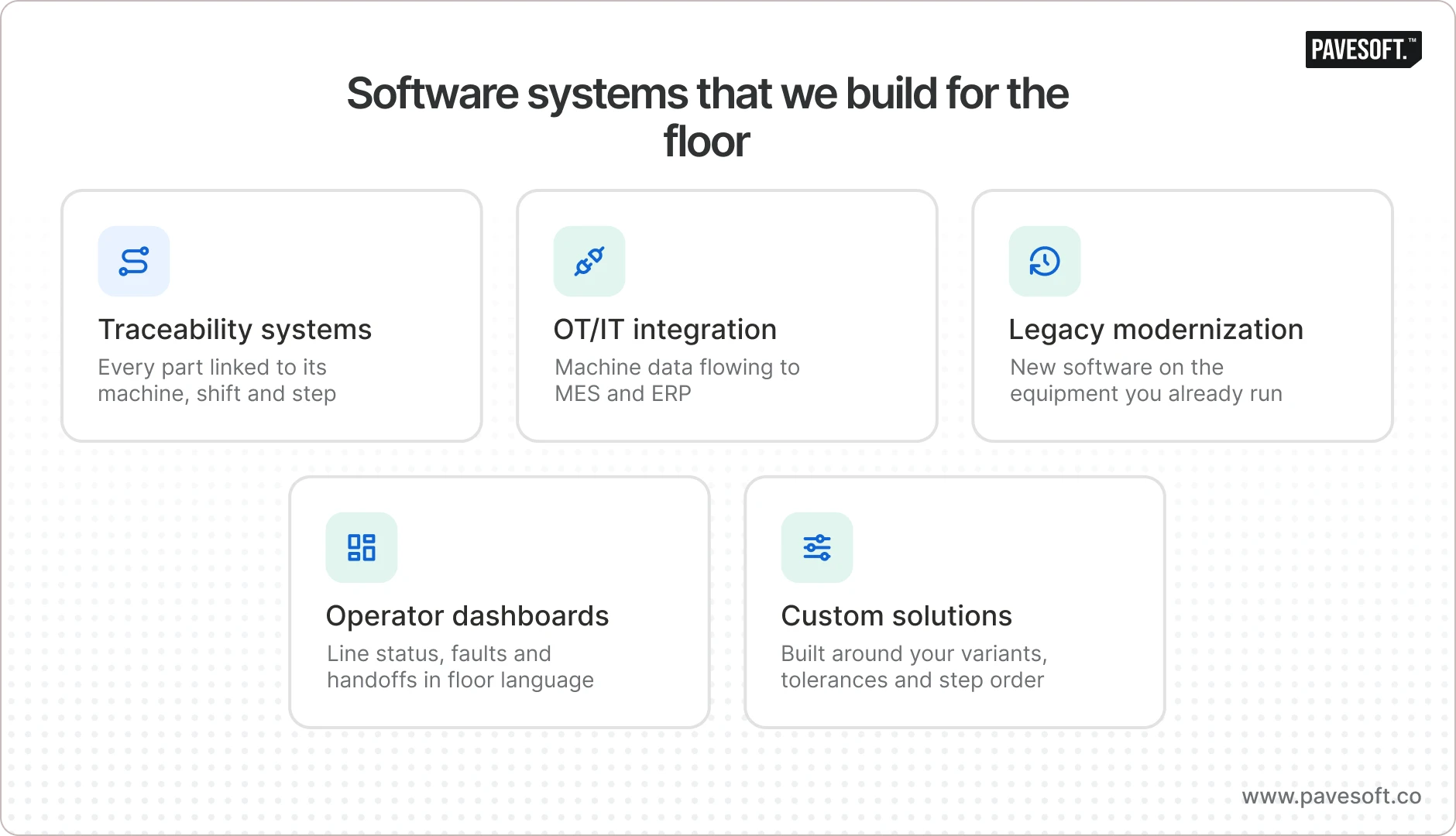
Legacy modernization: New software works with the controllers and equipment you already run. You get modern visibility without a rip-and-replace.
Operator workflows and floor dashboards: Control panels and live views are built for operators and shift supervisors. They show line status, faults, and handoff notes in the language the floor uses.
Custom solutions for your process: When your line has its own variants, tolerances, and step order, we build around them. In one deployment, a single line now runs four OEM variants without manual switching.
Paveway Automation covers the physical layer: PLCs, sensors, robotic cells, and conveyor controls. Our software connects to it directly, so data moves from the machine to the report without gaps.
How we deliver
Requirements reach phase-one go-live in 4 to 5 weeks. We work in weekly milestones, and your floor team sees working software every week.
Requirements from the roots: We walk the floor with your operators and shift supervisors. We map the process, the machines, and the signals each one sends. Then we agree on the result phase one must deliver.
Weekly builds: Each week ends with working software in front of your floor team. A wrong turn gets caught in days, so rework risk stays low.
Acceptance testing before the floor: We test edge cases and network interruptions in a controlled environment first. Then we repeat the tests on site.
Phased cutover: We go live in stages and run the new system alongside the old one. The line keeps its momentum while the floor team builds trust in the new tools.
We stay until it works: We don't bill by the hour and walk away. We stay until the results show up on the floor.
Grounded in 50+ projects
Pavesoft has delivered 50+ projects for industrial and automotive manufacturers. That work taught us what plant managers and operations directors deal with every day.
It also shaped how we build. As Atharva Kulkarni, Founder at Pavesoft, puts it: “I’ve seen too many good teams build the wrong thing brilliantly.
At Pavesoft, we’re obsessed with understanding requirements from the roots. It’s the only way to build something that actually holds.”
Software that fits your floor
Operations leaders do not need generic agency software or months of ramp-up. They need engineers who speak the language of the floor on day one.
When software is built around your machines, your controllers, and your process, the floor team sees what is happening as it happens. Plants run more predictably, and go-live stops being a risk.
What is the “translation-cost” problem?
The biggest cost in such an engagement is not the hourly rate. It is the ongoing translation cost; the time your plant experts spend teaching developers about general industrial processes.
The 2026 ICIS research on outsourced software projects confirms that this kind of domain-specific knowledge creates measurable coordination problems.
Manufacturing runs on knowledge that lives in people’s heads. Operators know which fault codes matter and which ones they ignore.
Shift supervisors know why a batch gets held. None of it sits in a requirements document, so someone has to pull it out. Every hour that takes is an hour you pay for.
This is an industry-wide gap, not a failure of any one team. Most software teams have never worked on a plant floor, so they start from zero.
The cost shows up in three places:
Discovery runs for months while developers learn your vocabulary.
The build solves the wrong problem because a requirement got lost in translation.
The floor team rejects the first release, and the rework starts.
To close this exact gap, you need a team that does not require a domain ramp-up. A team that has built 50+ enterprise-grade software in complex and regulated environments like yours.
What zero ramp-up and no rework looks like
On a typical project, the first 3-4 weeks are for the domain ramp-up where the team is made familiar with the processes and terminology. The technical requirements gathering comes after.
At Pavesoft, we have teams that specialize in building software for heavy industrial operations. Our engineers already know operators, fault codes, shift handoffs, and line-stops.
In addition to that, Paveway Automation, our integration partner for the physical layer, already knows the PLCs, sensors, and line controls.
Requirements move to phase one, and your floor team sees working software every week.
Comparing with the alternatives
The table below shows where each route lands.
In-house team | Large consultancy | Staff augmentation | Pavesoft Technologies | |
|---|---|---|---|---|
Where translation cost lands | In the months spent hiring and teaching new developers | In fees, while the team learns your operation | In rework after the build misses your process | Nowhere. The domain knowledge arrives with the team |
Domain knowledge on day one | Built over time | Broad, not specific to your floor | Rarely | Manufacturing-specific from week one |
Floor and software coordination | Your team manages it | Split across vendors | Your team manages it | One partnership with Paveway Automation |
Who owns the outcome | You do, long after the project ends | The contract scope | You do | We do. We stay until results show on the floor |
How Pavesoft built a traceability software for a tier 1 automotive supplier
A Tier-1 automotive supplier needed to expand an assembly line with precise per-part traceability software.
While Paveway Automation handled the floor, Pavesoft built the software and data layer. Our engineers started with the supplier’s real process, so nobody spent weeks teaching developers how the line runs.
The line moved from batch-level to unit-level traceability with two major outcomes:
Units condemned per defect event: from 1,000 to 10,000 down to 1.
Assembly cycle time per unit: from about 14 minutes down to 8 to 10 minutes.
What we build at Pavesoft Technologies
We build the software systems that run the shop floor. Our work falls into five areas.
Traceability systems: Every part links to the machine, shift, and process step that made it. When a defect appears, the floor team finds the affected units in seconds and scraps only those.
OT/IT integration: Machine data reaches your MES and ERP through OPC-UA, Modbus TCP, Ethernet/IP, and MQTT. Nothing gets trapped in a machine-level silo.
Legacy modernization: New software works with the controllers and equipment you already run. You get modern visibility without a rip-and-replace.
Operator workflows and floor dashboards: Control panels and live views are built for operators and shift supervisors. They show line status, faults, and handoff notes in the language the floor uses.
Custom solutions for your process: When your line has its own variants, tolerances, and step order, we build around them. In one deployment, a single line now runs four OEM variants without manual switching.
Paveway Automation covers the physical layer: PLCs, sensors, robotic cells, and conveyor controls. Our software connects to it directly, so data moves from the machine to the report without gaps.
How we deliver
Requirements reach phase-one go-live in 4 to 5 weeks. We work in weekly milestones, and your floor team sees working software every week.
Requirements from the roots: We walk the floor with your operators and shift supervisors. We map the process, the machines, and the signals each one sends. Then we agree on the result phase one must deliver.
Weekly builds: Each week ends with working software in front of your floor team. A wrong turn gets caught in days, so rework risk stays low.
Acceptance testing before the floor: We test edge cases and network interruptions in a controlled environment first. Then we repeat the tests on site.
Phased cutover: We go live in stages and run the new system alongside the old one. The line keeps its momentum while the floor team builds trust in the new tools.
We stay until it works: We don't bill by the hour and walk away. We stay until the results show up on the floor.
Grounded in 50+ projects
Pavesoft has delivered 50+ projects for industrial and automotive manufacturers. That work taught us what plant managers and operations directors deal with every day.
It also shaped how we build. As Atharva Kulkarni, Founder at Pavesoft, puts it: “I’ve seen too many good teams build the wrong thing brilliantly.
At Pavesoft, we’re obsessed with understanding requirements from the roots. It’s the only way to build something that actually holds.”
Software that fits your floor
Operations leaders do not need generic agency software or months of ramp-up. They need engineers who speak the language of the floor on day one.
When software is built around your machines, your controllers, and your process, the floor team sees what is happening as it happens. Plants run more predictably, and go-live stops being a risk.
“Before automation, scaling our operations felt chaotic. Now everything runs in the background — and we focus on growth instead of maintenance”
FAQ's
What is translation cost?
Why can’t template software fit a manufacturing process?
How long does it take to reach go-live?
How do Pavesoft and Paveway Automation work together?
Know exactly what you're building before you commit to it.
One discovery call. A clear scope, a realistic timeline, and no obligation.
Know exactly what you're building before you commit to it.
One discovery call. A clear scope, a realistic timeline, and no obligation.
Know exactly what you're building before you commit to it.
One discovery call. A clear scope, a realistic timeline, and no obligation.
PAVESOFT.
Pavesoft Technologies LLP
Our partners
Paveway Automation Pvt. Ltd.
Quick links
Get in Touch
Office address
For business enquiries
For HR and careers
PAVESOFT.
Pavesoft Technologies LLP
Our partners
Paveway Automation Pvt. Ltd.
Quick links
Get in Touch
Office address
For business enquiries
For HR and careers